PROTOCOL 143
Slivar
1. Documentations
https://github.com/brentp/slivar
2. Description
Slivar is a set of command-line tools that
enables rapid querying and filtering of VCF files. It facilitates operations on
trios and groups and allows arbitrary expressions using simple javascript.
Annotation can also be performed without
filtering (see section 6).
3. Installation
3.1. Local
or cluster
Use the link
https://github.com/brentp/slivar/releases/tag/v0.2.7
Select "slivar" and download the file.
Move the file into
\\wsl$\Ubuntu-20.04\home\gael\bin
Or into
/pasteur/zeus/projets/p01/BioIT/gmillot/bin
3.2. Docker
image
https://hub.docker.com/r/gmillot/slivar_v1.0/
See protocol 134
sudo docker pull gmillot/slivar_v1.0:gitlab_v8.11
4. Commands
https://github.com/brentp/slivar#attributes
Warning: any expression can be interpreted in bash before execution. To avoid this, use single quotes instead of double quotes.
5. slivar-functions.js
file
This file gather all the functions that can be used for the slivar executions. In the following link are basic functions :
https://github.com/brentp/slivar/blob/master/js/slivar-functions.js
But we can download and add additional homemade functions.
Example:
C:\Users\gael\Documents\Git_projects\08002_bourgeron\bin\slivar-functions.js
var config = {min_GQ: 20, min_AB: 0.20, min_DP: 6}
// hi quality variants
function hq1(sample) {
if (sample.unknown || (sample.GQ <
config.min_GQ)) { return false; }
if ((sample.AD[0] + sample.AD[1]) <
config.min_DP) { return false; }
if (sample.hom_ref){
return
sample.AB < 0.02
}
if(sample.het) {
return sample.AB >= config.min_AB
&& sample.AB <= (1 - config.min_AB)
}
return
sample.AB > 0.98
}
// functions to be use with
--family-expr
function
find_het_aff_hom_ref_unaff(indiv) {
if(!hq1(indiv)){ return false; } // test
first if quality is ok. It is faster since return false and go the the next
line directly
return
indiv.het == indiv.affected && indiv.hom_ref == !indiv.affected
// indiv.het: take the GT field of FORMAT of
indiv that is 0/1
// indiv.affected: take indiv that is 2 in
the ped file
// indiv.hom_ref: the GT field of FORMAT of
indiv that is 0/0
// !indiv.affected: take indiv that is 1 in
the ped file
}
6. Annotation
file input
Use the ones from Freddy:
Connect to maestro
then
cd /pasteur/zeus/projets/p02/ghfc_wgs_zeus/references/GRCh37/slivar-gnotate
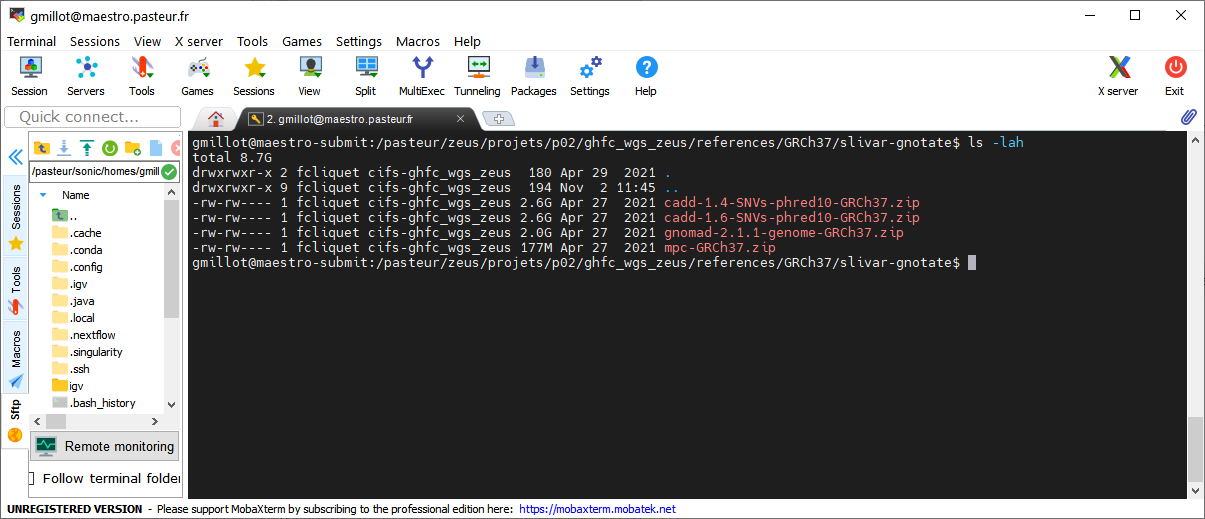
cadd-1.6-SNVs-phred10-GRCh37.zip phred10 because annotation only for variant with phred >= 10. Otherwise, too many variants (9 Billions). See https://cadd.gs.washington.edu/info for phred. Phred10 means that 90% of the variants are removed from the initial file.
gnomad-2.1.1-genome-GRCh37.zip with a caution: contains only worldwide and non-finnish-european info to lighten the file.
For annotation only, without filtering, see https://github.com/brentp/slivar/wiki/gnotate
7. Description
of outputs
The first fields, down to CSQ, come from gatk calling.
chr:pos:ref:alt as indicated
genotype(sample,dad,mom) 0 = homozygote REF, 1 = heterozygote, 2 = homozygote ALT
AC Allele count among the individuals of the pedigree
AF AC / AN, i.e., allele frequency in the pedigree
AN Allele number among the individuals of the pedigree (22 means 11 individuals)
BaseQRankSum
DB
DP depth of coverage
ExcessHet
FS
InbreedingCoeff
MLEAC
MLEAF
MQ Mapping quality (max 60).
MQRankSum
QD
ReadPosRankSum
SOR
VQSLOD
culprit
VEP annotation:
CSQ VEP annotation
cadd_phred cadd and phred score from cadd-1.6-SNVs-phred10-GRCh37.zip. -1means 1) no data, i.e., variant never seen before or 2) filtered out in the cadd annotation file used (phred10 cutoff for instance) or 3) indel. In the latter case, go the cadd website for the cadd of this specific indel https://cadd.gs.washington.edu/info
Gnomad annotation:
gno_non_neuro_af_all allele frequency of non neuro worldwide (all ancestries) cohorte in gnomade file gnomad-2.1.1-genome-GRCh37.zip
gno_non_neuro_af_nfe idem but non-finnish europeans
gno_non_neuro_nhomalt_all number of ALT homozygotes (it is to see the recessivity)
gno_non_neuro_nhomalt_nfe
Slivar annotation:
highest_impact_order See https://github.com/brentp/slivar/blob/master/src/slivarpkg/default-order.txt (from most impacting to less impacting). The order is defined by par Ensembl (http://www.ensembl.org/info/genome/variation/prediction/predicted_data.html) and as they say, this order can be subjective
aff_only example added by slivar, names of the affected indiv
depths(sample,dad,mom) example added by slivar, depth of coverage
allele_balance(sample,dad,mom) example added by slivar, proportion of reads carrying the ALT variant
8. Expr
command
https://github.com/brentp/slivar#expr
Label (and optionnally filter lines) a VCF according to trios or groups or family infos.
The output VCF is never modified, except the labelling added in the INFO field for some of the variants that fit the filtering.
Lines of the VCF can be selected for the filter labeling using the --pass-only option.
Options:
-v, --vcf=VCF path to VCF/BCF
--region=REGION optional region to limit evaluation. e.g. chr1 or 1:222-333 (or a BED file of regions)
-x, --exclude=EXCLUDE BED file of exclude regions (will never output excluded variants regardless of pass-only flag)
-j, --js=JS path to javascript functions to expose to user
-p, --ped=PED pedigree file with family relations, sex, and affected status
-a, --alias=ALIAS path to file of group aliases
-o, --out-vcf=OUT_VCF path to output VCF/BCF (default: /dev/stdout)
--pass-only if not used, slivar expr only add filtering info in the INFO field of the VCF. If used, only output lines of the VCF (i.e., variants) that pass at least one of the 4 expression filters below
--skip-non-variable don't evaluate expression unless at least 1 sample is variable at the variant this can improve speed
The 4 following ones add a label in the INFO
field of the VCF
--trio=TRIO expression(s) applied to each trio where 'mom', 'dad', 'kid' labels are available; trios inferred from ped file.
--family-expr=FAMILY_EXPR expression(s) applied to each family where 'fam' is available with a list of samples in each family from ped file.
--group-expr=GROUP_EXPR expression(s) applied to the groups defined in the alias option [see: https://github.com/brentp/slivar/wiki/groups-in-slivar].
--sample-expr=SAMPLE_EXPR expression(s) applied to each sample in the VCF.
--info=INFO expression using only attributes from the INFO field or variant. If this does not pass trio/group/sample expressions are not applied.
-g, --gnotate=GNOTATE path(s) to compressed gnotate file(s)
-h, --help Show this help
Example:
salloc -p common
sample_path="/pasteur/zeus/projets/p02/ghfc_wgs_zeus/WGS/Dyslexia/vcf/Dyslexia.gatk-vqsr.splitted.norm.vep.merged.vcf.gz"
fun_path="/pasteur/zeus/projets/p01/BioIT/gmillot/08002_bourgeron/bin/slivar-functions.js"
ped_path="/pasteur/zeus/projets/p01/BioIT/gmillot/08002_bourgeron/dataset/Dyslexia.pedigree.txt"
annot1_path="/pasteur/zeus/projets/p02/ghfc_wgs_zeus/references/GRCh37/slivar-gnotate/cadd-1.6-SNVs-phred10-GRCh37.zip"
annot2_path="/pasteur/zeus/projets/p02/ghfc_wgs_zeus/references/GRCh37/slivar-gnotate/gnomad-2.1.1-genome-GRCh37.zip"
${ZEUSHOME}bin/slivar expr
--js $fun_path -g $annot1_path -g $annot2_path --vcf $sample_path --ped
$ped_path --pass-only -o "res.vcf" --family-expr "aff_only:fam.every(find_het_aff_hom_ref_unaff)"
9. Tsv
command
https://github.com/brentp/slivar#tsv
https://github.com/brentp/slivar/wiki/tsv:-creating-a-spreadsheet-from-a-filtered-VCF
Convert a filtered and annotated VCF to a TSV.
One line per variant and per individual. Using "affected only", only the affected patients will be present in the tsv file.
Options:
-p, --ped=PED required ped file describing the trios in the VCF
-c, --csq-field=CSQ_FIELD INFO field containing the gene name and impact. Usually CSQ or BCSQ
--csq-column=CSQ_COLUMN CSQ sub-field(s) to extract (in addition to gene, impact, transcript). may be specified multiple times.
-s, --sample-field=SAMPLE_FIELD
INFO field(s) that contains the sample names (indiv) that have passed previous filters. Can be specified multiple times.
-g, --gene-description=GENE_DESCRIPTION
tab-separated lookup of gene (column 1) to description (column 2) to add to output. the gene is case-sensitive. can be specified multiple times.
--impact-order=IMPACT_ORDER
ordering of impacts to override the default (https://raw.githubusercontent.com/brentp/slivar/master/src/slivarpkg/default-order.txt)
-i, --info-field=INFO_FIELD
INFO field(s) that should be added to output (e.g. gnomad_popmax_af) can also use 'ID' or 'QUAL' to report those variant fields.
-o, --out=OUT path to output tab-separated file (default: /dev/stdout)
-h, --help Show this help
Example:
salloc -p common
sample_path="/pasteur/zeus/projets/p01/BioIT/gmillot/08002_bourgeron/results/PL_family_WGS_20211207"
ped_path="/pasteur/zeus/projets/p01/BioIT/gmillot/08002_bourgeron/dataset/Dyslexia.pedigree.txt"
cd $sample_path
${ZEUSHOME}bin/slivar tsv
--ped $ped_path -s aff_only -i AC -i AF -i AN -i
BaseQRankSum -i DB -i DP -i ExcessHet -i FS -i InbreedingCoeff -i MLEAC -i
MLEAF -i MQ -i MQRankSum -i QD -i ReadPosRankSum -i SOR -i VQSLOD -i culprit -i
CSQ -i cadd_phred -i gno_non_neuro_af_all -i gno_non_neuro_af_nfe -i gno_non_neuro_nhomalt_all
-i gno_non_neuro_nhomalt_nfe -i highest_impact_order -i aff_only -c Allele $sample_path/res.vcf
> $sample_path/res.tsv
# -p --ped pedigree file
# -s --sample-field field of --family-expr of slivar exp
instruction, before the colon. Above it is aff_only
# -c --csq-field field of VEP info in the INFO column of the
vcf file, identified by CSQ. Create a new column ""gene_impact_transcript"
in the tsv file. Possible to select
only part of the info by using something like -c CSQ=. See the .vcf comments to
have the field names of the CSQ field. Use -i CSQ to get the whole CSQ column
#-i field the INFO column in the vcf file